The Donner DP-1 Guitar Power Supply review is most relevant to players who want to power several effects from one compact unit.
Its ten outputs cover common 9V needs alongside one 12V and one 18V output, though the output limits make checking each pedal’s requirements essential.
Donner DP-1 Review Summary
The quick verdict
7,000+ ratings
Read Amazon ReviewsDonner DP-1 Guitar Power Supply
A practical fit for guitarists who need several pedal outputs with a mix of 9V, 12V, and 18V requirements.
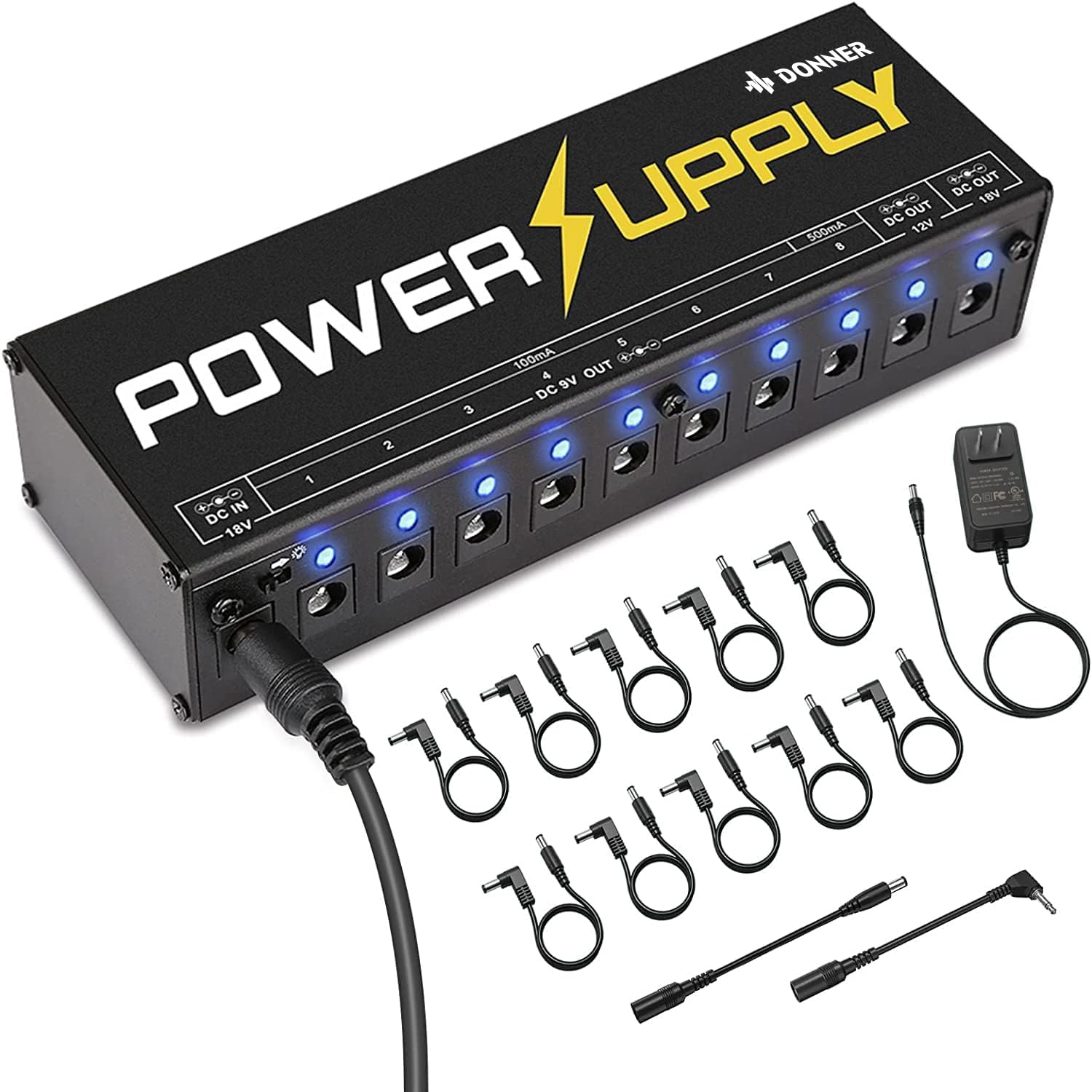
- Ten outputs: seven 9V outputs at 100mA, one 9V output at 500mA, one 12V output at 100mA, and one 18V output at 100mA.
- AC 100–240V input with an 18V DC supply input.
- Includes ten power cables with barrel connectors.
- Aluminum-alloy enclosure in a compact rectangular form, weighing 6.9 ounces.

Pros
- Ten outputs can consolidate power for a board with several pedals.
- The voltage mix accommodates pedals designed for 9V, 12V, or 18V operation.
Consider before buying
- Most outputs are rated for only 100mA, so the current requirement of each pedal needs checking.
- There is just one 9V output rated at 500mA; pedals needing more current may not match the available output mix.
Read the full review summary
The DP-1 combines ten pedal outputs, a lightweight aluminum-alloy enclosure, and ten included power cables in a compact rectangular form.
Its output mix—seven 9V outputs rated at 100mA, one 9V output rated at 500mA, one 12V output rated at 100mA, and one 18V output rated at 100mA—can suit a board with several modest-current pedals and a few different voltage needs.
A built-in noise-reduction design, blue indicator light, and independent short-circuit protection add practical touches for a pedalboard setup.
Donner describes the outputs as isolated through circuit simulation and design, while also clarifying that this does not mean absolute circuit isolation.
Treat it as a convenient multi-output supply, and compare every pedal’s voltage, polarity, connector, and current requirements with the supply and included cables before connecting.
The buying factors
Donner DP-1 Scorecard
Editorial scores reflect listed features and buyer fit; they are not laboratory measurements or customer ratings.
Output count and mix
Ten outputs cover three voltage levels, including a single higher-current 9V output.
Current flexibility
The 500mA 9V output helps with a more demanding pedal, while most outputs are limited to 100mA.
Board-friendly design
The compact rectangular aluminum-alloy enclosure weighs 6.9 ounces.
Setup convenience
Ten power cables are included, and the blue LED provides an at-a-glance indicator.
Protection and noise features
A noise-reduction design and independent short-circuit protection are useful considerations for a multi-pedal setup.
Isolation clarity
The design aims to provide an isolation effect, but Donner notes that it is not absolute circuit isolation.
Key Features and Specifications of Donner DP-1
- Ten outputs: seven 9V outputs at 100mA, one 9V output at 500mA, one 12V output at 100mA, and one 18V output at 100mA.
- AC 100–240V input with an 18V DC supply input.
- Includes ten power cables with barrel connectors.
- Aluminum-alloy enclosure in a compact rectangular form, weighing 6.9 ounces.
- Noise-reduction circuit design and independent short-circuit protection for each output.
- Blue LED indicator for pedalboard lighting and short-circuit indication.
Pros and Cons of Donner DP-1
Pros
- Ten outputs can consolidate power for a board with several pedals.
- The voltage mix accommodates pedals designed for 9V, 12V, or 18V operation.
- Ten included cables reduce the need to source basic power leads separately.
- Lightweight aluminum-alloy construction and a compact rectangular design suit pedalboard use.
- Independent short-circuit protection is designed to let unaffected outputs continue working if one output is shorted.
Consider before buying
- Most outputs are rated for only 100mA, so the current requirement of each pedal needs checking.
- There is just one 9V output rated at 500mA; pedals needing more current may not match the available output mix.
- The isolation design does not provide absolute circuit isolation, which may matter to buyers seeking fully isolated power.
Who Should Buy Donner DP-1?
Good fit
Consider the DP-1 if your board has several pedals whose voltage and current needs fit its ten-output layout.
The seven 100mA 9V connections suit lower-current devices, while the 500mA 9V output offers a higher-current option within the same unit.
Its 12V and 18V outputs can help accommodate a mixed-voltage board, provided the pedals are specifically designed for those voltages.
Before buying, make a list of each pedal’s required voltage and current, then check connector and polarity compatibility as well; matching the voltage alone is not enough.
The included cables and compact aluminum-alloy enclosure make it a straightforward option for consolidating a board’s power connections.
If the design’s isolation description matters to your setup, weigh Donner’s qualification that the circuit-simulation approach does not mean absolute isolation.
Who should skip it
Skip this model if your pedals collectively need more current than its output ratings allow, or if several pedals need a higher-current 9V output than the single 500mA connection can provide. Check every device’s current draw before deciding.
Look elsewhere if your setup specifically requires absolute circuit isolation. Donner’s description expressly limits what its isolation design means, so buyers with strict isolation requirements should confirm that another supply meets them.
How the Donner DP-1 Fits a Mixed Pedalboard
Match each output to a pedal
The DP-1’s ten connections are not interchangeable in voltage or current capacity. Seven are 9V/100mA, one is 9V/500mA, and the remaining two provide 12V/100mA and 18V/100mA.
Map each pedal to an output that meets its specified voltage and current draw, and check connector and polarity compatibility before powering the board.
Plan around the current limits
The single 500mA output is the supply’s largest stated 9V option; the other nine connections are each rated at 100mA.
That makes the distribution important: a board with many low-current pedals may use the outputs efficiently, while a pedal with a larger current requirement needs a suitably rated connection.
Do not assume that having ten outputs means ten high-current connections.
Understand the isolation qualification
Independent short-circuit protection is described per output, so a short on one connection is designed to leave the others working.
Donner also describes an isolation effect created through circuit simulation and switching-supply design, but says it is not absolute circuit isolation. Buyers who depend on a particular isolation standard should verify that the supply’s design meets that need.
Consider the physical setup
The aluminum-alloy rectangular enclosure weighs 6.9 ounces, and the package includes ten barrel-connector power cables. Those details support a compact, cable-ready board arrangement.
The blue LED can provide a visible indicator and some pedalboard lighting, while the short-circuit indication offers a visual cue when troubleshooting.
Alternatives to Donner DP-1
No alternative model is recommended here. Compare the output voltages, current ratings, isolation design, and cable compatibility that matter to your board before choosing another supply.
Is Donner DP-1 Worth It?
The Donner DP-1 is worth considering for a multi-pedal board whose devices fit its specific output mix. Ten connections, three voltage options, included cables, and per-output short-circuit protection make it a practical candidate for consolidating power.
Buy only after checking each pedal’s voltage, current, connector, and polarity needs against the available outputs.
Its current capacity is concentrated in one 500mA 9V output, and its isolation design is not described as absolute, so those limits should guide the decision.
Your review at a glance
7,000+ ratings
Read Amazon ReviewsDonner DP-1 Guitar Power Supply
A practical fit for guitarists who need several pedal outputs with a mix of 9V, 12V, and 18V requirements.
- Ten outputs: seven 9V outputs at 100mA, one 9V output at 500mA, one 12V output at 100mA, and one 18V output at 100mA.
- AC 100–240V input with an 18V DC supply input.
- Includes ten power cables with barrel connectors.
- Aluminum-alloy enclosure in a compact rectangular form, weighing 6.9 ounces.